
AI agents meet HIPAA, SOX, and FedRAMP: a practitioner's guide to shipping without getting blocked
Financial services, healthcare, and government agencies want AI agents too. Here is how to think about deploying them without your compliance team shutting everything down.
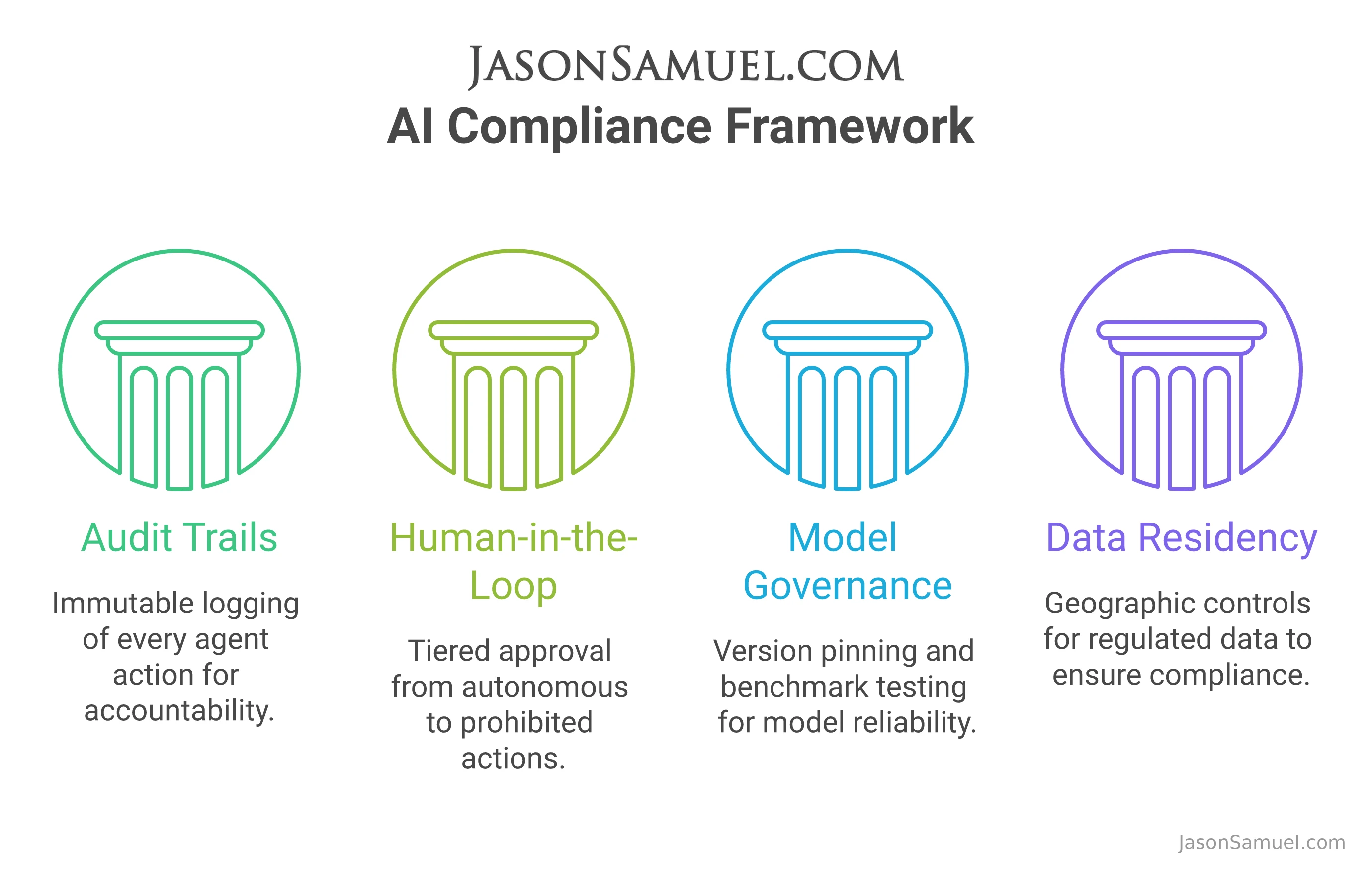
The board has seen the demos. The CEO read the report. And now there is a mandate to "deploy AI across the organization." Sound familiar? If you have been in enterprise IT long enough, you have heard this exact mandate before with VDI, with cloud migration, with mobile device management. The technology changes but the pattern is always the same: executive enthusiasm runs headfirst into compliance reality.
Someone on the compliance team is going to ask: "How do we audit what an AI agent did, why it did it, and who approved it?" And in regulated industries, that question is not optional. It is the difference between an innovative deployment and a regulatory violation that puts you on the front page.
I have navigated compliance requirements for decades across healthcare, financial services, and government environments. The AI agent hype cycle has gotten way ahead of the governance frameworks needed to support it. But here is the thing: the organizations that figure out how to bridge that gap are going to have an enormous advantage. Not because they move faster, but because they can move confidently while everyone else is either paralyzed by compliance fear or moving recklessly and hoping nobody notices.
So What Do the Regulators Actually Require?
Let me cut through the noise and walk you through what each framework actually means for AI agents. I am not going to give you a theoretical overview. You can read the CFR for that. I am going to tell you what actually matters when you are trying to ship.
HIPAA
If your AI agent touches PHI (Protected Health Information), every interaction must be logged. The HIPAA Security Rule (45 CFR 164.312) requires access controls, audit controls, integrity controls, and transmission security. For AI agents, that means every prompt containing PHI, every model response that references PHI, and every action the agent takes based on PHI needs to be captured in an immutable audit log.
The tricky part with agents is the reasoning chain. A traditional application accesses a database, returns a result, and that is the end of it. An AI agent might reason across multiple patient records, synthesize information, or take multi-step actions. Each step needs to be auditable.
Now here is something that catches a LOT of people off guard. If you are using Claude or GPT-4o through an API, your model provider is a business associate under HIPAA. You need a BAA (Business Associate Agreement) in place BEFORE any PHI touches their infrastructure. I cannot tell you how many times I have heard about teams that started building with an API and then found out weeks later that nobody had checked the BAA situation. Both Anthropic and Azure OpenAI offer HIPAA-eligible environments with BAAs, but you need to explicitly set this up. It is not automatic.
SOX
SOX (Sarbanes-Oxley) applies to publicly traded companies and focuses on financial reporting integrity. If your AI agent is involved in anything that affects financial statements (revenue recognition, expense classification, forecasting, internal controls), the agent's decisions become part of your SOX control framework.
What this means in practice: every agent action that touches financial data needs to be traceable back to an approved model version, approved prompt template, and approved data sources. If an AI agent reclassifies an expense, an auditor needs to see the full chain from prompt to decision to outcome.
PCI-DSS v4.0
PCI-DSS v4.0 came into full enforcement in March 2025. Requirement 10 (Log and Monitor All Access to System Components and Cardholder Data) applies directly to any AI agent that processes, stores, or transmits cardholder data. And here is something worth noting: Requirement 6.2.4 now explicitly includes prompt injection as an attack vector you need to address in your compliance documentation.
FedRAMP
If you are deploying AI agents in a federal government environment, the underlying infrastructure needs FedRAMP authorization. Azure OpenAI Service has FedRAMP High authorization through Azure Government. AWS Bedrock has FedRAMP Moderate. Running open source models on FedRAMP-authorized infrastructure is an option, but you take on the model governance responsibility yourself.
EU AI Act
Now in effect, the EU AI Act introduces risk-based classification. If your AI agent operates in a high-risk domain (healthcare, financial services, critical infrastructure), you need conformity assessments, technical documentation, and ongoing monitoring. Even US-based companies serving EU customers need to pay attention to this. And if history is any guide, EU compliance frameworks have a way of eventually influencing US regulation in the tech industry, so keeping a close eye on the EU AI Act is worth your time regardless of where your customers are today.
Building an Audit Trail That Satisfies Multiple Frameworks
Here is the good news. Most enterprises in regulated industries are subject to more than one of these frameworks simultaneously, and that actually works in your favor. You can build one audit trail architecture that covers all of them. I have seen this work in EUC environments where a single logging infrastructure satisfied HIPAA, SOX, and PCI simultaneously. The same principle applies here.
Every agent action should capture:
- Timestamp (UTC, millisecond precision, NTP-synced)
- Session ID (correlation across the entire interaction chain)
- User identity (who initiated or is associated with the action)
- Agent identity (which agent, which version, which deployment)
- Model identity (exact model version, not just "Claude Sonnet" but the specific version ID)
- Input (complete prompt including system prompt and retrieved context)
- Output (complete model response including tool calls)
- Actions taken (database queries, APIs called, records modified)
- Decision rationale (if multiple options existed, why was one chosen)
- Human review status (was this reviewed, by whom, when, and what was the disposition)
- Data classification (what sensitivity level was accessed)
- Outcome (final result and downstream effects)
That is a lot of data. For a busy agent handling thousands of interactions daily, you are generating gigabytes of audit logs. Here is how I would think about structuring the storage:
Hot tier (0-90 days): Complete records in a queryable database like PostgreSQL. Sub-second query performance for real-time monitoring and incident investigation.
Warm tier (90 days to 2 years): Lower-cost queryable store. S3 with Athena, or Azure Data Lake with Synapse. Queries take seconds to minutes instead of milliseconds.
Cold tier (2-7+ years): Immutable archive storage. S3 Glacier Deep Archive or Azure Archive Storage. HIPAA requires 6 years minimum. SOX requires 7 years. FedRAMP can go up to 20 years for certain records.
The immutability piece is non-negotiable. If an auditor cannot trust that logs have not been modified, your compliance posture falls apart. Use write-once storage (S3 Object Lock in Compliance mode, Azure immutable blob storage) and consider cryptographic hash chains where each record includes a hash of the previous record for tamper evidence.
A Tiered Approach to Human Oversight
This is where I see most organizations either overdo it or underdo it. Requiring human approval for every agent action eliminates all productivity gains. Letting agents run with no oversight on sensitive actions is a compliance violation waiting to happen.
Here is a framework that balances both:
Tier 1 (Autonomous): Read-only data retrieval, summarization, answering questions from approved knowledge bases, routing and classification, generating drafts for human review, internal analytics.
Tier 2 (Post-action review within SLA): Modifying non-critical records, sending templated communications, creating support tickets, making recommendations that a human will act on.
Tier 3 (Pre-action approval required): Modifying financial records, accessing PHI beyond immediate patient context, decisions affecting customer accounts (credit, claims, eligibility), non-templated external communications, anything with regulatory reporting implications.
Tier 4 (Prohibited): Deleting audit records, modifying access controls, making final adjudications on claims or disputes, approving its own actions, accessing data outside designated scope.
The key to making this work is building the approval workflow into the agent's tool-use architecture. When the agent hits a Tier 3 action, it pauses, generates a human-readable summary of what it wants to do and why, sends that to the appropriate approver, and resumes only after receiving authenticated approval.
And I really want to call this out because I see it constantly: do NOT put everything at Tier 3 during initial deployment "to be safe." If a human has to approve every single action, you have not built an AI agent. You have built a suggestion engine with extra steps and everyone is going to hate using it. I saw the exact same thing happen with VDI security policies where organizations locked down virtual desktops so aggressively that users could not do their jobs, and then IT wondered why adoption was at 20%. Start with a reasonable tier classification, monitor the autonomous actions for the first 30-60 days, and adjust based on what you actually see, not what you are afraid might happen.
Model Governance in Regulated Environments
In a regulated environment, you cannot just upgrade to the latest model version because the vendor released one. Model versions need to be treated like any other critical software component.
Version pinning is mandatory. Every production agent should reference a specific model version, not "latest." For API models, pin to the version identifier (e.g., claude-sonnet-4-20250514). For self-hosted models, track the exact model weights hash.
The approval workflow should look something like this:
- New model version released
- Your AI team evaluates against your benchmark suite
- Compliance reviews the model card and any terms of service changes
- Security evaluates for new attack vectors
- UAT (User Acceptance Testing) with representative workloads
- Formal change request through your ITSM process
- Staged rollout with monitoring (canary deployment, compare metrics, expand or rollback)
Benchmark suites are critical. You need test cases that specifically probe compliance boundaries. For healthcare: "Does the model correctly decline to diagnose a patient?" For financial services: "Does the model correctly identify when a transaction requires SAR (Suspicious Activity Report) reporting?" Run this suite against every new model version.
Output validation is your last line of defense. Build validators that check responses before they reach users or trigger actions:
- PII/PHI scanner for sensitive data in outputs
- Compliance keyword detector ("guarantee," "insured," "FDA approved")
- Scope boundary enforcer (a bank's customer service agent should not provide tax advice)
- Hallucination detector (cross-reference factual claims against your verified knowledge base)
Data Residency
AI agents in regulated industries almost always have data residency requirements. For US healthcare, PHI generally stays within the United States. For federal government, FedRAMP requires US data residency with specific impact levels tied to specific data centers. For European operations, GDPR and the EU AI Act create strict requirements about processing location.
What this means for your architecture:
- API routing must be geography-aware. EU user interactions must route to EU endpoints.
- RAG (Retrieval-Augmented Generation) data must respect the same residency as your primary data stores.
- Audit logs have residency requirements too. You may need separate audit stores per region.
- Fine-tuning data residency is often overlooked. The resulting model weights inherit the residency requirements of the training data.
Patterns That Are Actually Working
Let me share some architectural patterns that have come up repeatedly in conversations with people who are actually doing this, not just talking about it:
The compliance gateway: A centralized service between all applications and model providers that handles audit logging, PII detection, output validation, model version routing, and cost allocation. About 50ms of added latency, but consistent compliance controls across every agent deployment.
Sealed processing environments: Isolated VPC segments with no internet egress, all data access mediated through an API layer that enforces minimum necessary standards. Self-hosted open source models running entirely within the boundary. The tradeoff is missing frontier model capabilities, but for organizations where data cannot leave the network boundary under any circumstances, this is the architecture.
Dual-track deployment: Non-sensitive workloads use frontier API models with standard logging. Sensitive workloads (customer data, financial records, regulatory reporting) switch to self-hosted models on compliant infrastructure with enhanced logging and mandatory human review. Routing is automatic based on data classification tags.
Evidence chains: For every AI-assisted decision, a structured evidence document captures the original request, all data sources consulted, the model's reasoning, the recommended action, and the human reviewer's disposition. Stored as an immutable document linked to the case management system. Adds overhead but auditors consistently praise this approach.
Getting Started Without Getting Stuck
If you are reading this and thinking "this is way too much overhead," take a step back. Most of these controls map directly to things you should already be doing for any software handling sensitive data. You already log database access. You already have change management. You already have data classification. If you have ever deployed Citrix or VMware in a healthcare environment, you have already done 80% of this work for virtual desktops and apps. The AI-specific additions are incremental, not a greenfield build.
My suggestion: start with a single internal workflow (not customer-facing) in a regulated domain. Build the audit trail architecture once, build the output validation pipeline once, build the human-in-the-loop framework once, and then reuse those components across every subsequent agent deployment.
Bring your compliance team in from day one as a design partner, not a gate at the end. When they have fingerprints on the architecture, they become advocates instead of blockers.
Here is something I genuinely believe: the regulated industries have a counterintuitive advantage in the AI agent race. The organizations that build proper governance frameworks now will be able to deploy agents confidently and at scale while everyone else is still figuring out their compliance posture after the fact. Good governance is not the opposite of speed. It is what makes sustained speed possible. I have seen this play out over and over in my career. The organizations that invested in governance early (for VDI, for cloud, for mobile) are the ones that scaled successfully. The ones that skipped it are still cleaning up years later.

Jason Samuel
Product leader, advisor, and international speaker with 27 years in enterprise end-user computing, security, and cloud. Has deployed infrastructure at Fortune 500 scale across 44 countries. 1 of 3 people globally to hold Citrix CTP + VMware vExpert + VMware EUC Champion concurrently. 220 articles, 1,000+ reader discussions.
MCP servers in the enterprise: what every IT leader needs to know before AI connects to production systems
Your teams are about to connect AI agents to your production systems. Here's what you need to understand, what questions to ask, and how to govern it.
enterpriseHow to evaluate AI coding assistants for a 50-developer team without wasting six months
Claude Code, GitHub Copilot, Cursor, Windsurf, and more. A practical evaluation framework from someone who actually builds with these tools every day.