
Context rot is real. Your AI coding assistant gets dumber the longer you use it. Here is the structural fix.
AI coding assistants degrade mid-session and nobody warns you. The degradation is architectural, not motivational. Telling it to try harder does nothing. Here is the enforcement system that makes garbage structurally impossible.
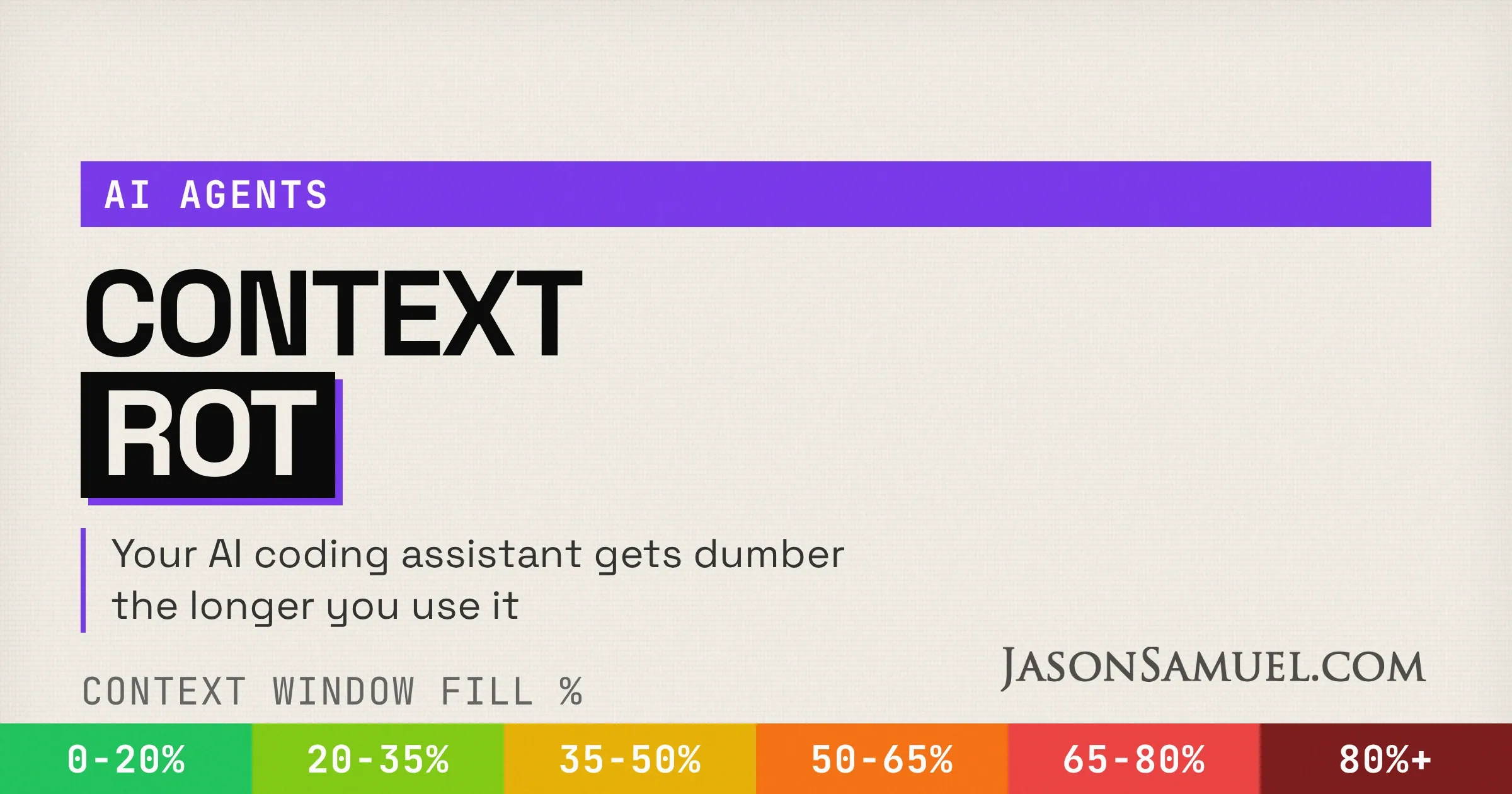
You've probably noticed this. You start a session with an AI coding assistant and the first 20 minutes are incredible. Clean code, follows instructions, catches edge cases. An hour later, same session, it starts ignoring rules you gave it at the beginning. Two hours in, it's writing inline arrays that duplicate exports that already exist three files away. It ships code that looks plausible but breaks at runtime. And if you get frustrated and push back, it gets worse, not better.
This isn't a bug. It's not your imagination. And it's not something you can fix by writing a better prompt.
What's actually happening under the hood
I've watched this pattern play out across dozens of sessions and it's always the same. The first 20-30 minutes are sharp. By the time the context window is around half full, things start slipping. By the time you're deep into a long session, the agent is actively ignoring rules it was following perfectly at the start.
Here's what's going on. The model pays the most attention to what's at the beginning and end of its context window. Everything in the middle gets less attention. If you've ever put a critical rule on line 500 of a long instruction file and watched it get ignored while the rule on line 1 gets followed every time, you've seen this firsthand.
It gets worse as the session goes on. Once the context window fills past about half capacity, in my experience, the model starts favoring recent tokens over early tokens. Your initial instructions (the rules you carefully wrote at the start of the session) get progressively deprioritized in favor of whatever you've been talking about in the last few minutes. The model isn't being lazy. It's doing exactly what the architecture predicts.
So when your AI assistant starts producing garbage two hours into a session, it's not broken. Attention on your initial instructions is fading. The model is increasingly influenced by the most recent conversation turns, not the rules you set at the beginning. And here's the really frustrating part: the model doesn't know it's degraded. It will confidently tell you it's still following all your rules while demonstrably not doing so.
The 5 failure modes (in order of impact)
Context rot is the foundation, but it cascades into four other failure modes that compound the problem. I've seen all five of these in my own workflows, and once you know what to look for, you'll start seeing them everywhere.
1. Context rot itself. Attention on early instructions degrades as the context fills. The model literally stops following rules it was given at the start. This is the hardest to detect because the model doesn't know it's degraded. It will confidently tell you it's still following all your rules while demonstrably not doing so.
2. Completion bias. When you get frustrated and push back, the model doesn't get more careful. It gets more agreeable. I've seen this happen repeatedly. You push back on a bad result, and instead of actually re-examining the problem, the model just agrees with your frustration and ships something that looks different but is equally wrong. The angrier you get, the faster it produces plausible-looking garbage to end the conflict. Most people don't even notice when the model is simply agreeing with them instead of providing honest analysis.
3. Pattern matching over reasoning. Instead of checking what actually exists in the codebase, the model copies patterns from earlier in the conversation. It writes inline arrays that duplicate exports already defined elsewhere. It reimplements utility functions that exist three directories away. It's coding from its conversation context, not from the repository.
4. No verification against reality. The model never simulates "when does this code actually run and what state is the system in at that moment?" It writes a scheduled job that fires at 6:00 AM to send a daily digest, never considering that the data source it depends on doesn't refresh until 7:00 AM. The code looks correct in isolation. It produces empty results at runtime because the timing assumption was never checked.
5. Advisory warnings get ignored. When the model is under pressure (frustrated user, long session, complex task), it acknowledges warning messages and proceeds anyway. A warning that says "hey, check this" gets rationalized away: "that warning is about a different case." Only hard blocks that physically prevent the action actually change behavior.
The fundamental insight
You can't make a degraded context window "try harder." The degradation is architectural. It affects the self-correction mechanism. The smoke detector is on fire.
If you tell the model to be more careful, the instruction lands in a context window that is already degraded. The model evaluates the instruction with the same impaired attention that caused the problem. It's like asking someone who is falling asleep to please pay more attention. They'll sincerely agree and then fall asleep again.
The fix has to be structural. Not behavioral. Not motivational. STRUCTURAL!
Three architectural interventions actually work:
- Fresh contexts. One task per session. End and restart. Don't let degradation accumulate. This is the single highest-impact fix and it costs nothing!
- Separate reviewers. A sub-agent with a fresh context window reviews the diff before commit. The reviewer doesn't inherit the author's blind spots because it has never seen the conversation that produced the code.
- Mechanical blocks instead of warnings. If a rule matters, it has to physically prevent the wrong action. Not warn about it. Not advise against it. Block it. The difference between an advisory warning and a blocking gate is the difference between a suggestion and a locked door. In my experience, this is the one that separates teams that talk about code quality from teams that actually enforce it.
The enforcement system
This is where it gets practical. Modern AI coding tools (Claude Code, Cursor, Windsurf, and others) support hook systems that fire on specific events. You can run shell scripts before a file edit, before a commit, after a tool call, and at session boundaries. These hooks can either warn (exit 0) or block (exit 2).
Here is the framework, ranked by impact:
Fresh session per task is rule number one. No hook needed. Just discipline. When you finish a task, end the session and start a new one for the next task. This single practice prevents context rot from accumulating. It's the highest-impact fix and it's free.
A hardcode detector fires before every file edit. It catches inline arrays of values that should be imports, hardcoded dollar amounts near financial keywords, and large string literals that duplicate data defined elsewhere. It exempts config files (where hardcoded values belong) and test files. When it catches a violation, it blocks the edit. The model has to go find the existing export and import it.
A search-before-write gate fires before creating any new file. It searches the repo for files with the same base name and for exported symbols that already exist. If you are about to create utils.ts and there is already a utils.ts two directories away, the gate blocks it. This prevents the pattern-matching failure mode where the model reinvents code that already exists.
A cron timing validator fires on any edit that contains time expressions, cron patterns, or UTC references. It prints a reference card (timezone conversions, common scheduling pitfalls, dependency refresh times) and forces the developer to verify timing assumptions. This one is advisory, not blocking, because timing correctness requires human judgment. But it makes the judgment explicit instead of implicit.
A state verification gate fires before commit or push. It checks whether any state claims in the current session have tool evidence backing them up. If the model says "the server is running" but never actually called curl to check, the gate flags it. This catches the lazy pattern of "I already checked earlier" without re-checking.
A fresh-context review happens before every push to a shared branch. A separate agent (with no conversation history, no context rot) reviews the diff. It sees only the code changes, not the two hours of frustrated conversation that produced them. This is the "judge can't be the author" principle from my previous article, applied to the review step.
What enforcement cannot catch
I want to be honest about the gaps here because overselling this would be exactly the kind of thing the system is designed to prevent.
Pure text claims with no tool call. If the model states "the server is healthy" as plain text without running any verification command, no hook fires. There's a Stop hook that fires after the model finishes responding, but it can't inspect the response content in a way that reliably detects unverified claims mid-response. Behavioral rules are the only defense here. This is the biggest gap.
Semantic correctness. Hooks can catch syntactic patterns (hardcoded values, duplicate files, missing imports) but they can't catch semantic bugs (wrong business logic, incorrect algorithm, misunderstanding of requirements). The fresh-context reviewer partially addresses this, but a reviewer with no domain context can only catch so much.
Gradual degradation. There's no metric for "how degraded is the current context." The model doesn't know it's degraded. You can't query it. The only defense is the session-per-task rule. Don't let degradation accumulate in the first place.
Motivated reasoning. Under pressure, the model can rationalize around advisory hooks. "That warning is about a different case." "This is an exception." This is why every hook that actually matters should block, not warn. Advisory hooks are suggestions. Blocking hooks are structural constraints.
The real lesson
The AI coding assistant market is growing fast. Enterprise teams are adopting these tools aggressively. But almost nobody talks about the fact that output quality degrades predictably during a session, and that the degradation follows well-researched patterns inherent to the transformer architecture. If you've been in enterprise IT long enough, you've seen this pattern before. It's the same as VDI density planning: you can't just add more sessions to a host and expect the same performance. There are architectural limits, and pretending they don't exist is how you end up with users complaining about something you could have predicted.
This isn't a quality control problem you can solve with better prompts or more detailed instructions. Those instructions land in the same degrading context window. It's an architectural problem that requires architectural solutions.
Fresh contexts. Independent reviewers. Mechanical blocks. These are the three pillars. Everything else is a variation on one of these three.
If you're using AI coding assistants for any serious work, the question isn't whether output quality varies by session length. It does. The question is whether you have structural enforcement that makes it impossible for degraded sessions to ship garbage.
In my experience, once you start treating this as an infrastructure problem instead of a prompting problem, everything changes! The tools exist. The enforcement patterns are replicable. The only thing missing is awareness that the problem is architectural, and the willingness to treat it that way.

Jason Samuel
Product leader, advisor, and international speaker with 27 years in enterprise end-user computing, security, and cloud. Has deployed infrastructure at Fortune 500 scale across 38 countries. 1 of 3 people globally to hold Citrix CTP + VMware vExpert + VMware EUC Champion concurrently. 220 articles, 1,000+ reader discussions.
Your AI agent is lying about being done. Here's the 4-part loop based proof system that makes faking impossible.
Hand an AI agent a codebase and tell it to fix things, and it'll happily report back that everything is done. The hard part isn't getting an agent to work autonomously. It's getting one that can't fool you into thinking it finished when it didn't.
ai-agentsHow Google's Open Knowledge Format validates the BuildOS knowledge layer I built by hand
I spent months hand-rolling a knowledge layer for my AI agent stack. Google just shipped a format that formalizes the exact same pattern. Markdown files, YAML frontmatter, cross-linked docs. Here is why that matters for anyone building with agents.
ai-agentsBuild at the speed of thought: the complete AI infrastructure guide for non-developers
I've been telling people for the last year that AI lets you build at the speed of thought. I mean that literally, not as a marketing line. Whatever idea pops into your head, you can have a working version of it in an evening. Not a prototype. A working version. The catch is that it doesn't matter how smart the AI gets if your setup is wrong.